
Creativity & ownership
2.77 point gap
Jordana R. Goodman · audience winner
Higher averages on all four criteria.
Explore the score differencesOctober 21, 2026 · The Ferris
Two debates explored who owns AI-assisted creativity and how to make healthcare AI safer.
The gap between the speakers’ totals, on the same 20-point scoring system.
2.77 point gap
Jordana R. Goodman · audience winner
Higher averages on all four criteria.
Explore the score differences0.38 point gap
Maia Jacobs · audience winner
Higher averages on 2 criteria, lower on 1 and level on 1.
Explore the score differencesThese are performance scores, not percentages of the audience or a vote on either resolution.
01
Creativity & ownership
The resolution
Resolved: When AI contributes creativity equivalent to that of a joint author or joint inventor, the resulting work or invention should not receive patent or copyright protection.

For the motion
14.16/ 20

Against the motion
16.93/ 20
Audience winner
| Joshua D. Sarnoff | Criterion | Jordana R. Goodman |
|---|---|---|
3.57 | PersuasionHow convincing was the case? | 4.48 |
3.57 | EvidenceHow well was the case supported? | 4.0 |
3.48 | ClarityHow clearly was the case presented? | 4.2 |
3.55 | RefutationHow well did the speaker answer the other side? | 4.25 |
| 14.16 | Total / 20 | 16.93 |
Scores assess debate performance, not agreement with the resolution. Totals use unrounded criterion averages.
Goodman scored higher on all four criteria, with the largest gap in persuasion (+0.91).
Highest and lowest criterion averages, on the same 1–5 scale.
Goodman’s lowest criterion average (4.00) exceeded Sarnoff’s highest (3.57) by 0.43 points.
0.09 point range across criteria
0.48 point range across criteria
A narrow range means similar averages across the four criteria. It does not show whether individual audience members agreed.
A +0.50 clarity edge means a half-point gap between the speakers’ average clarity scores out of 5. Each criterion carries equal weight in the total.
Criterion gaps compare averages at the scorecard’s displayed precision. The official total and winning margin use unrounded scores, so rounded gaps may not add up exactly. “Level” means equal at displayed precision.
Averages alone do not show how much individual audience members agreed. These results do not measure a change of opinion about the resolution.
02
Healthcare AI
The resolution
Resolved: Over the next decade, efforts to make AI use in healthcare safer should prioritize human oversight over technical safeguards.

For the motion
14.97/ 20
Audience winner

Against the motion
14.59/ 20
| Maia Jacobs | Criterion | Manling Li |
|---|---|---|
3.72 | PersuasionHow convincing was the case? | 3.72 |
3.75 | EvidenceHow well was the case supported? | 3.91 |
3.97 | ClarityHow clearly was the case presented? | 3.47 |
3.53 | RefutationHow well did the speaker answer the other side? | 3.5 |
| 14.97 | Total / 20 | 14.59 |
Scores assess debate performance, not agreement with the resolution. Totals use unrounded criterion averages.
Jacobs led on clarity by 0.50 points; Li led on evidence by 0.16 points.
Highest and lowest criterion averages, on the same 1–5 scale.
Jacobs and Li each had a range of 0.44 points across the four criteria.
0.44 point range across criteria
0.44 point range across criteria
A narrow range means similar averages across the four criteria. It does not show whether individual audience members agreed.
A +0.50 clarity edge means a half-point gap between the speakers’ average clarity scores out of 5. Each criterion carries equal weight in the total.
Criterion gaps compare averages at the scorecard’s displayed precision. The official total and winning margin use unrounded scores, so rounded gaps may not add up exactly. “Level” means equal at displayed precision.
Averages alone do not show how much individual audience members agreed. These results do not measure a change of opinion about the resolution.
Each speaker receives four audience averages, scored from 1 to 5. Those unrounded averages are added for a total out of 20, then rounded for display. A gap under 0.05 points is a tie.
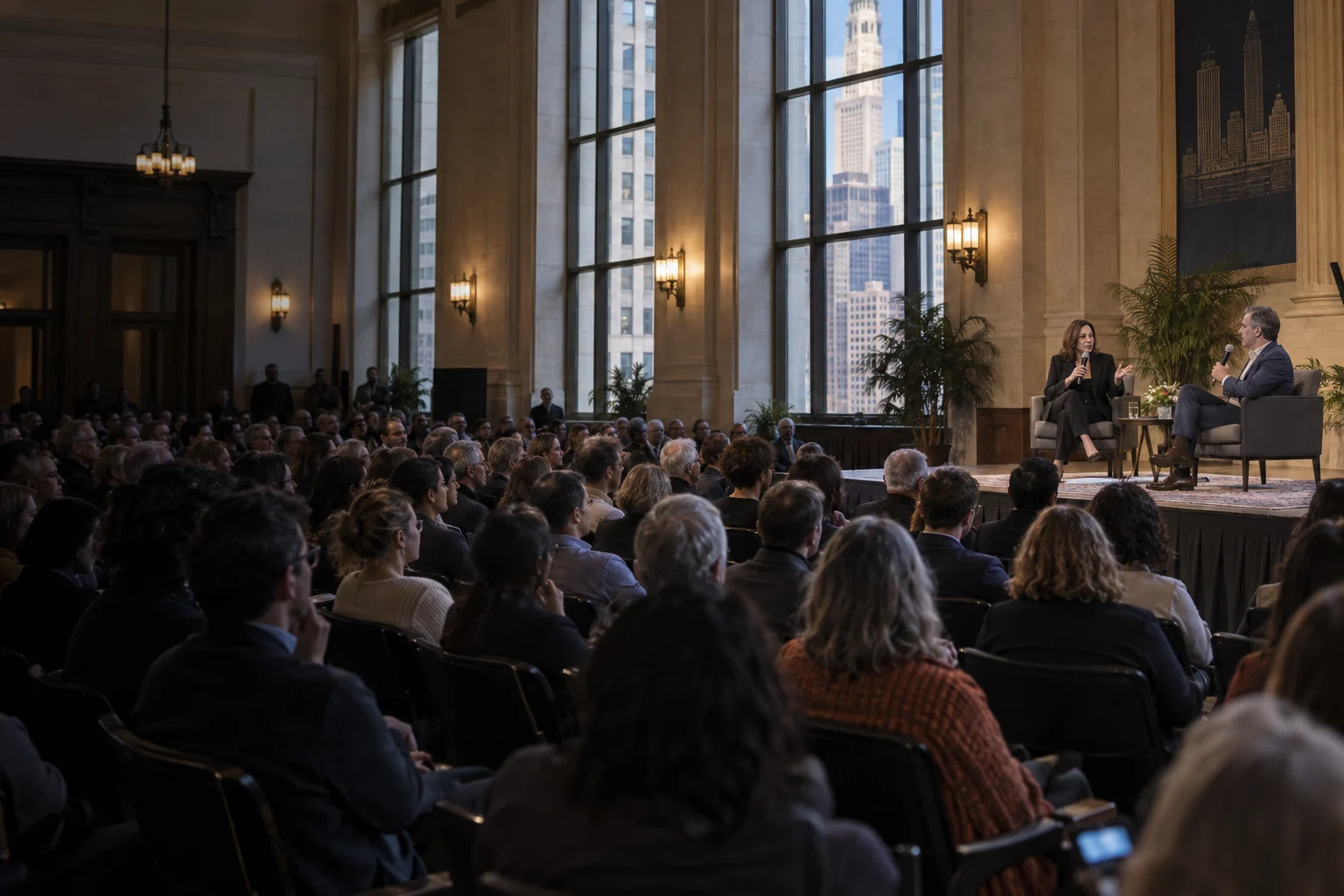
Thursday, November 19, 2026
The Ferris, 1 W. Monroe Street, Chicago, IL
Live debates, audience questions and a reception. Join the next Chicago evening of ideas.
Explore the next showcase